Can Technicians Game AppWork's Gamification? No, Here's Why.
We hear two questions about AppWork's gamification all the time. The first is "how exactly does it work?" The second usually follows right behind it: "can't a technician just rack up points by rushing through work orders?"
Both are fair questions. So let's answer them properly: how the system works, why it motivates both the quantity and the quality of the work, and the data integrity that's built into every layer so nobody can cheat their way to the top.
Where It Came From
AppWork's gamification wasn't dreamed up in a product meeting. It was built while we were running our own properties as a property management company, trying to solve a problem every operator knows too well: technician turnover.
Maintenance technicians do some of the hardest, most thankless work in multifamily. They fix the leak at 2 AM, turn the unit on a deadline, and keep residents happy. And historically, the only time anyone noticed their work was when something went wrong.
We built gamification to change that: to recognize great work automatically, every day, without a manager having to remember to say thank you. The result at our own company was a 33% increase in technician retention. That's why it became a core part of the platform.
The Three Pillars
AppWork's gamification stands on three pillars that work together.
1. Ratings and Reviews
When a technician completes a work order, the resident gets the completion notes by email and can rate the work and leave a review. That rating goes straight to the technician's profile.
This is the foundation of everything else, and it matters who's doing the rating: the resident, not the technician. Nobody scores their own work. The people who actually live with the repair decide whether it was a 5-star job.
2. AppWork Coins
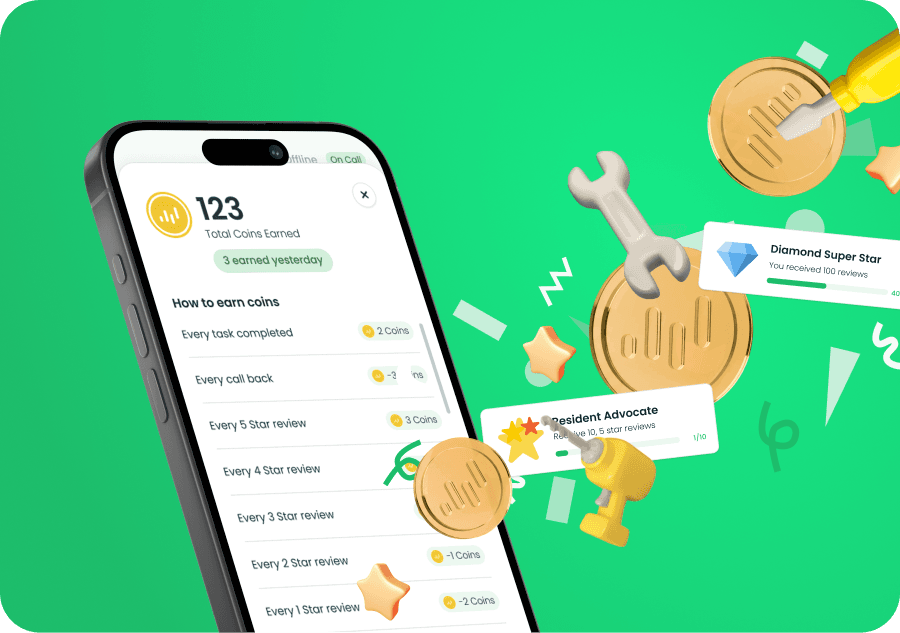
Coins are the points system, and this is where quantity and quality get tied together. Technicians earn coins for doing work:
- 20 coins for every completed work order
- 30 coins for a 5-star resident review
- 20 coins for a 4-star review
- 50 coins for earning a new badge
- 10 coins for monthly activity
And here's the part people miss when they assume the system can be gamed: technicians also lose coins when the work isn't done right.
- 50 coins for a callback (a reopened work order)
- 30 coins for a 1-star review
- 20 coins for a 2-star review
Notice the balance. A completed work order earns 20 coins, but a callback costs 50. A 5-star review is worth more than the completion itself, and a 1-star review wipes out the completion and then some. A technician who closes a pile of work orders without actually doing the work doesn't rocket up the leaderboard. They end up with significantly fewer coins than everyone else, because every callback and bad review drags them further down than the fake completion lifted them up.
Technicians see their lifetime coin total right in the AppWork Tech App, so the recognition is constant, not a once-a-year performance review.
3. Performance Badges
Badges mark milestones: work orders completed, make readies finished, inspections done. Your team can even configure custom badge tracks, so the goals match how your properties actually operate. Each new badge is a visible achievement in the app, and it comes with a 50-coin bonus.
The Part Everyone Asks About: Data Integrity
Here's the honest concern behind "can't they game it?": if points only counted completions, a technician could close work orders as fast as possible, quality be damned. AppWork was designed so that strategy backfires. Four safeguards make sure of it.
Residents hold the scorecard. Ratings come from residents after the work is done. A technician can't rate themselves, inflate their own scores, or hand-pick their reviewers.
Every work order requires proof. AppWork requires photo documentation and completion notes on every work order. No photo, no notes, no completion. Those notes are emailed directly to the resident, who can leave a review or, if the job wasn't actually done right, simply reopen the work order.
Poor work costs coins. As covered above, the coin system doesn't just reward, it penalizes. Run the math on a rushed job: close it sloppy, earn 20 coins, get the callback, lose 50. That's a net loss of 30 coins plus a second trip to the unit. Cutting corners is the single worst strategy in the entire system.
Managers see everything. Every work order, timestamp, photo, rating, and coin transaction is visible in the Admin Portal. If something unusual is happening, it shows up in the data immediately. There's nowhere for gamed numbers to hide.
Put those four together and the only way to win is the way you'd want your team to win anyway: complete a lot of work orders, document them properly, and leave residents happy.
Recognition Beyond the App
On top of the built-in features, AppWork runs recognition programs across our entire client base:
- Top Coin Earner: every month, the top technician at each client company receives a physical badge card in the mail.
- Chadwell Supply Leaderboard: the top 50 coin earners across all of AppWork compete each month (with a minimum coin threshold to qualify, for example 4,500 coins in a recent month), and winners receive a professional tool bag from Chadwell Supply.
- Top Maintenance Rating (TMR): four times a year, we recognize the top 50 properties by the percentage of work orders rated 4 to 5 stars, with a virtual badge and a physical trophy.
- Top Maintenance Company (TMC): once a year, we honor the top 15 operators by portfolio-wide positive-rating percentage.
These contests add fuel, but they're not what makes gamification work. The everyday features carry the impact on their own. The coins, ratings, and badges keep motivating teams whether or not anyone's chasing a trophy that month.
What Your Company Gets Out of It
Gamification isn't just a morale tool. It generates a kind of data this industry has never had before: a continuous, resident-verified record of every technician's output and quality.
Operators use it to answer questions that used to be pure guesswork. Who are your strongest technicians, and who needs coaching? Which properties consistently delight residents? Where do callbacks cluster? The answers are sitting in the data, updated with every completed work order.
Some of our clients take it a step further and build their own incentive programs on top of the platform, like monthly bonuses or prizes tied to coin totals and ratings. The scorekeeping is already handled and already trustworthy, so all they have to add is the reward. It's one of the most effective ways we've seen to build a real maintenance culture.
The Bottom Line
AppWork's gamification rewards the two things every operator wants more of: work getting done and work getting done well. And because residents do the rating, every job needs photo proof, callbacks cost more than completions earn, and managers see all of it, the system stays honest.
Recognized technicians stick around. We saw it firsthand with a 33% jump in retention, and our clients see it every day.
Want to see the coins, badges, and leaderboards in action? Book a demo and we'll walk you through it.