Why Maintenance Is the Last Frontier in Multifamily Tech
Somewhere in your portfolio right now, a work order is sitting on a clipboard and a turn is being tracked on a whiteboard in the maintenance shop. Meanwhile, the technician who knows every boiler in the building is updating his resume.
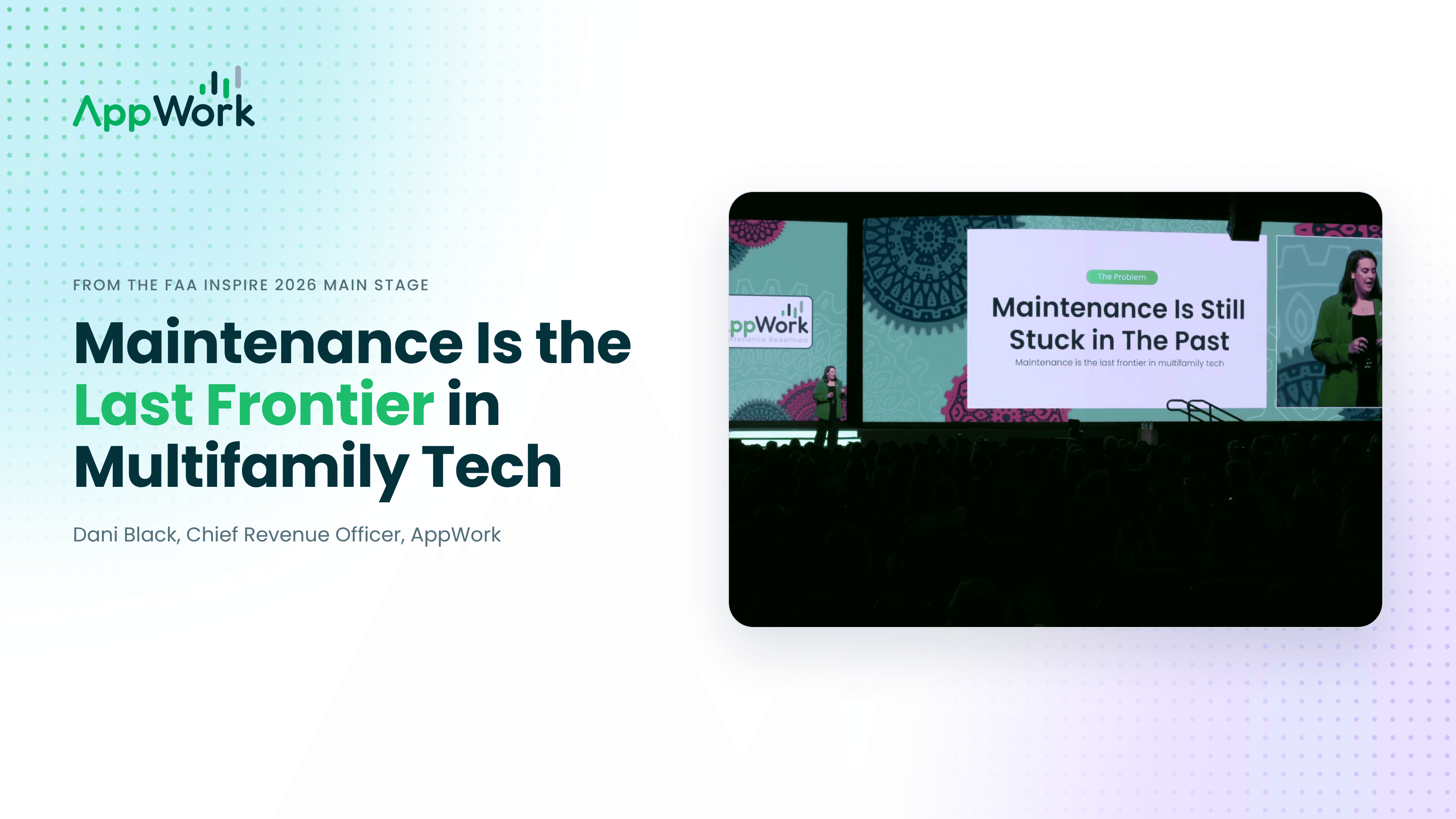
That was the picture Dani Black, AppWork's Chief Revenue Officer, painted when she opened FAA Inspire 2026, the Florida Apartment Association's annual conference. She had six minutes on the main stage before the keynote, and she spent them on one argument: multifamily has modernized leasing, marketing, payments and resident communication, and left maintenance running the way it ran in 1998.
The full session is above, or you can watch it on YouTube. Here is the case she made, with the numbers.
Why is maintenance the last frontier in multifamily tech?
Maintenance is the last frontier in multifamily tech because it is the one department that was never given tools built for the people doing the work. The leasing office got a CRM and accounting got automation. The maintenance shop got a module bolted onto the property management system, designed for whoever sits at a desk, not for the tech standing in a unit with a wrench in one hand.
Dani put it plainly on stage: maintenance is critical to the operation and chronically underfunded and undersupported. A surprising number of teams still run on paper work orders. Turns get managed on whiteboards. Information lives in one person's head, and when that person leaves, so does the information.
It is not that operators do not see the problem. They see it every day. The issue is what happens when they try to fix it, which is the subject of the next two sections.
What does maintenance technician turnover actually cost?
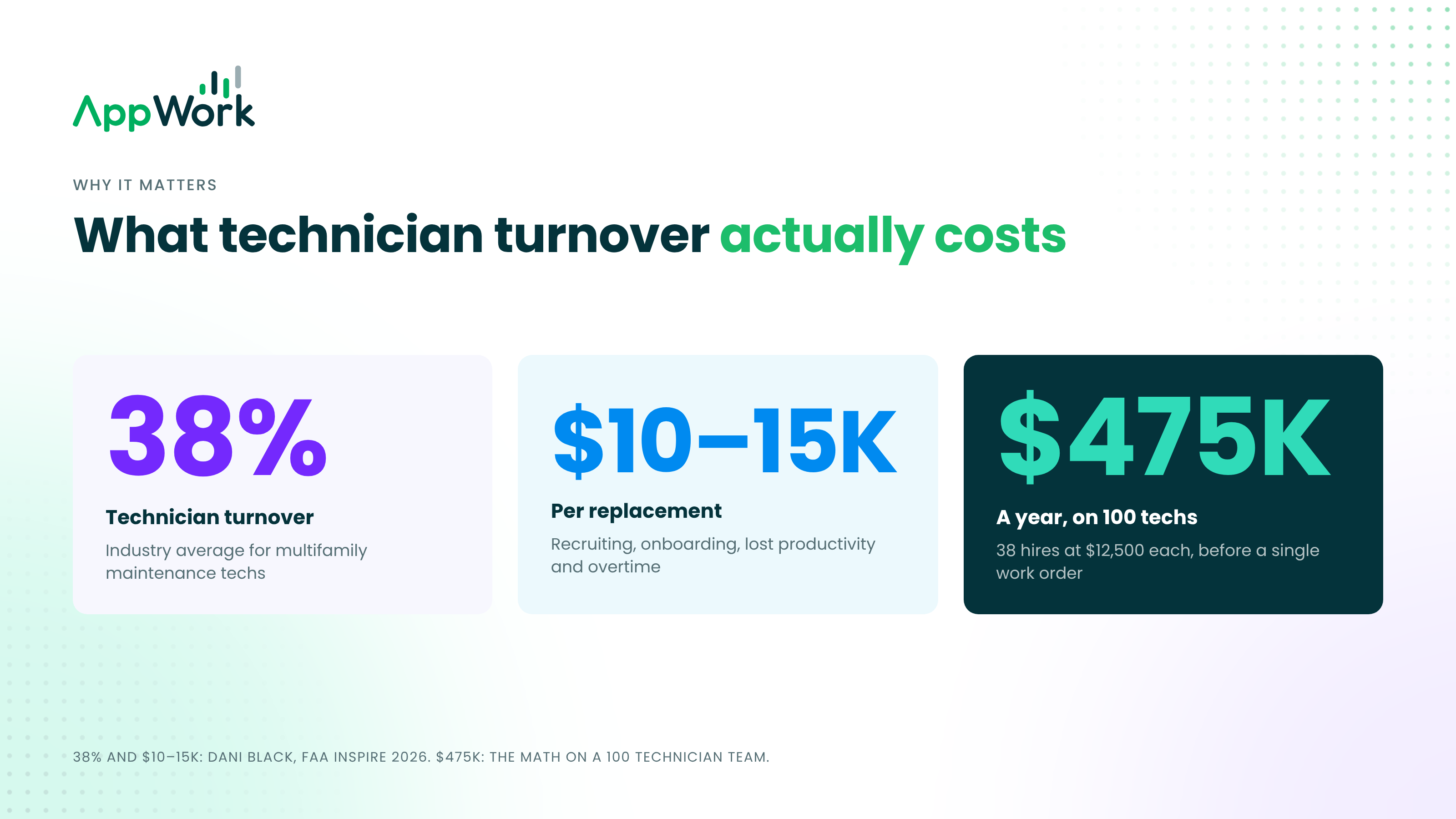
Maintenance technician turnover in multifamily runs around 38%, and replacing a single technician costs $10,000 to $15,000 once you count recruiting, onboarding, lost productivity and the overtime that covers the gap. Those were the two figures Dani anchored the session on, and the arithmetic is uncomfortable.
Take a 10,000 unit portfolio with roughly 100 techs. At 38% turnover, you are hiring 38 technicians a year. At $12,500 each, that is $475,000 a year in replacement cost before you count a single work order. That number never shows up on a budget line called "turnover." It is spread across overtime, contractor invoices, recruiter fees and the regional manager's weekends.
Then there is the part you cannot invoice. When a tech leaves, the remaining team absorbs the load. Response times slip and residents notice. Corners get cut on preventive work, and a cut corner on a water heater or a dryer vent is not a small thing. Vacant units sit longer because nobody has time to turn them, so you lose rent on top of everything else.
Dani's point was not that turnover is bad. Everyone in the room knew that. Her point was that most operators have accepted it as a cost of doing business when it is actually a symptom of how the job has been set up.
Why does maintenance software fail on site?
Most maintenance software fails on site because it was built for the office and handed to the field. The tools are clunky, training is a one-hour webinar nobody remembers, and change management falls on a maintenance supervisor who already has 40 open work orders. Six months in, the techs are back on paper and the software is a line item nobody wants to talk about.
Dani described the pattern from the operator's side, because that is where she comes from. An operator invests in technology. The rollout is rough. Adoption stalls. The next time someone pitches maintenance software, the answer is a polite no, because they have already been burned once. Maintenance ends up as the afterthought in the tech stack not because it does not matter, but because the last attempt did not stick.
The lesson she drew was simple. If the tool is intimidating, the team will not use it, and a tool nobody uses has an ROI of zero no matter what the demo looked like.
What do modern maintenance operations look like?
Modern maintenance operations run on one platform the technicians actually use, give managers real visibility without a spreadsheet, and treat recognition as part of the system rather than an annual pizza party. That was the shape of the second half of Dani's session, and it maps to how AppWork was built.
Information lives in one person's head, and when that person leaves, so does the information.
Built by the people who did the job. AppWork was made by property managers, for property managers, and refined over nine years on site and shaped by technician feedback. Dani's framing on stage: we are not here to check a box on mobile work orders. We are here to fix what has been broken for a long time.
One platform, one flow. Work orders, inspections, make readies, preventive maintenance, inventory and reporting live in one place. The techs see what is assigned to them. The manager sees what is open, what is late and where. Nobody is reconciling a whiteboard against a PMS report at the end of the week.
Adoption that actually happens. The Tech App is simple enough that a technician barely needs to be trained on it, and AppWork trains them anyway, live and in person, at no extra cost. It works offline in a basement with no signal. It translates English to Spanish. Every screen has been reworked based on what techs said they needed.
Real visibility, real ROI. Managers and regionals get live dashboards, portfolio and property level Insight Reports, turn timelines and interactive property maps that make it obvious where a problem is before it becomes an emergency.
Recognition that retains. Techs earn coins for the work they do. Coins roll up to a leaderboard. Top performers earn the Top Maintenance Rating. Techs stay at companies where they feel seen, and most of them have never had a visible, running record of what they contribute. Now they do.
Techs stay at companies where they feel seen, and most of them have never had a visible, running record of what they contribute
The Tech App itself was built for the way techs work: a Trash Out and a Move In are different jobs with different checklists, and the app knows the difference.
What results do AppWork clients see?
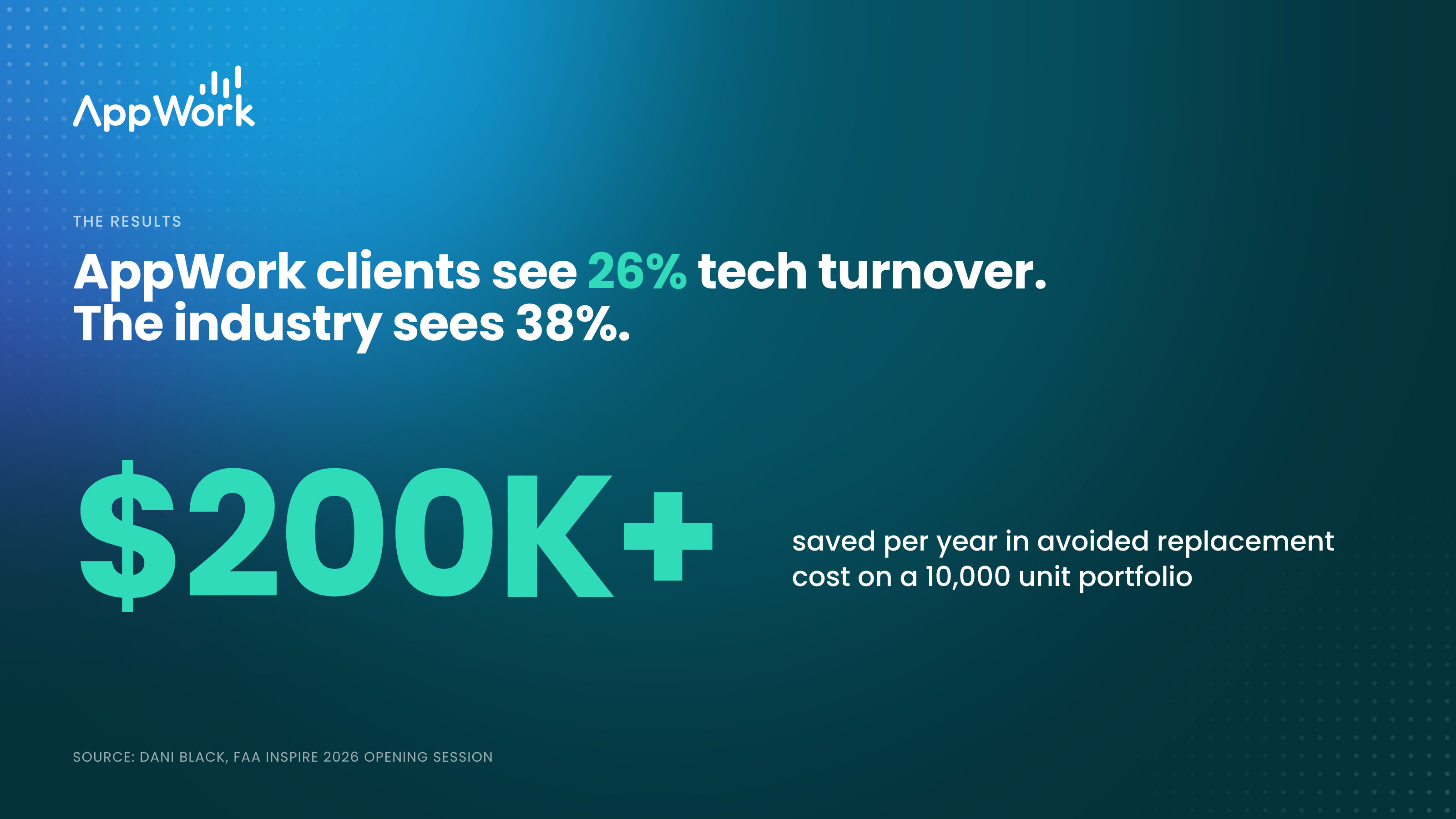
AppWork clients see 26% technician turnover against the industry's 38%, which on a 10,000 unit portfolio works out to more than $200,000 a year in avoided replacement cost. Those were the closing numbers of the session, and they are the ones worth remembering, because they tie the whole argument together. Give techs a tool they will use and recognize the work they do, and they stay.
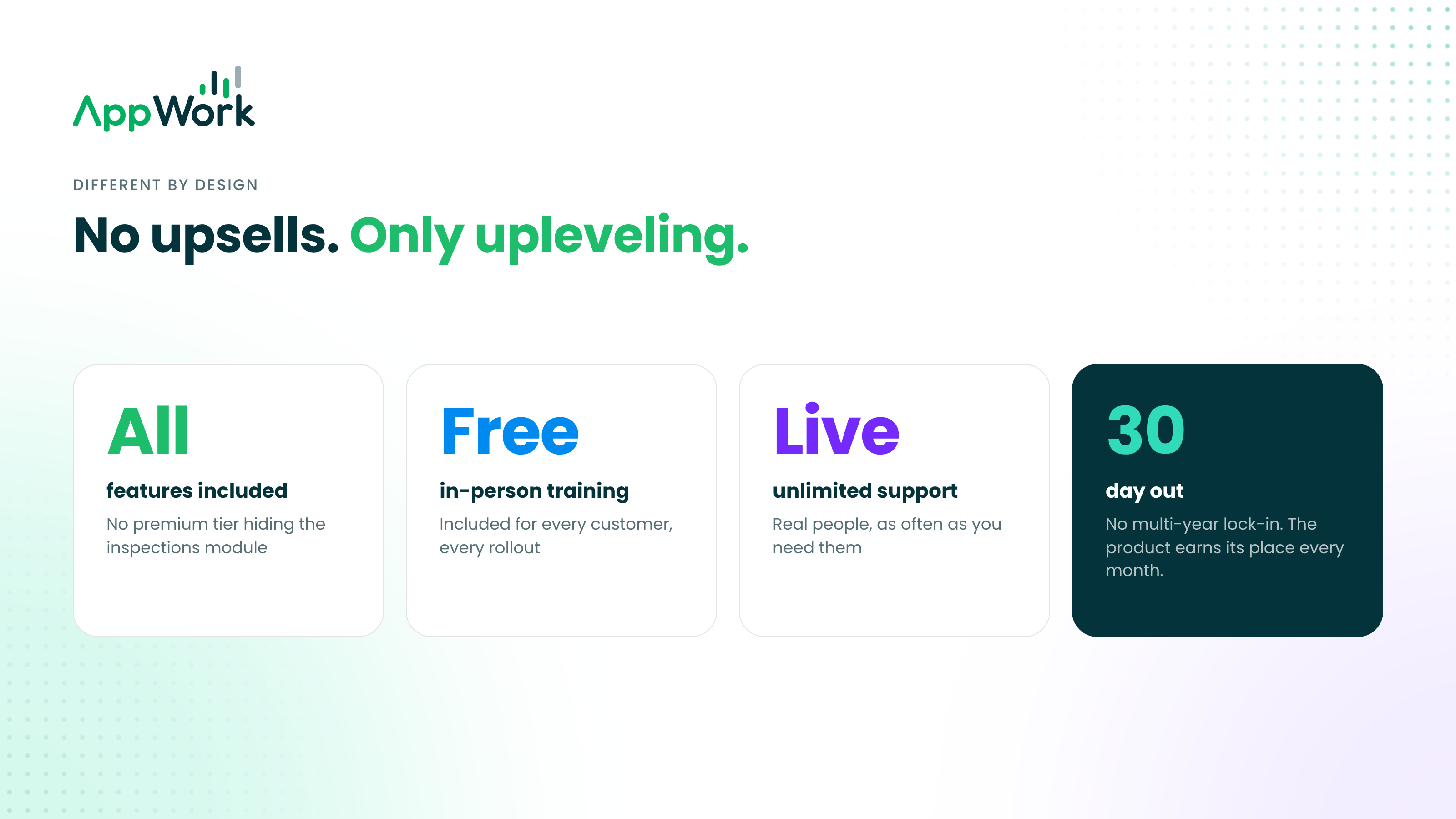
The pricing model matters here too, because it is part of why adoption sticks. Dani summed it up as no upsells, only upleveling:
- Every feature is included. There is no premium tier hiding the inspections module.
- Live, in-person training is included.
- Support is live and unlimited.
- Contracts are 30 day out. No multi-year lock-in, which means the product has to earn its place every month.
For an operator who has been burned by a rollout before, that last point does a lot of work. The risk of trying sits with the vendor, not the property.
Frequently asked questions
What is the average turnover rate for maintenance technicians in multifamily? Around 38%, the figure Dani Black cited at FAA Inspire 2026. AppWork clients run at 26%.
How much does it cost to replace a maintenance technician? $10,000 to $15,000 per technician when you include recruiting, onboarding, lost productivity and the overtime or contractor spend that covers the vacancy.
Why do maintenance teams still use paper work orders? Because the software they were given was built for the office, not the field. When a tool is slow or dies the moment there is no signal, techs go back to what works, and paper always works.
What should multifamily maintenance software include? Work orders, inspections, make ready tracking, preventive maintenance, inventory and reporting in one system, with a mobile app technicians will use without a manual. Live training and offline mode are the two features most often skipped in a demo and most often missed on site.
How does recognition reduce maintenance tech turnover? Maintenance is a job where good work is invisible by design. Nobody calls when the boiler runs. A coins program and a leaderboard make the work visible to the tech and to everyone above them, and people stay where their work is seen.
Who is Dani Black? Dani Black is Chief Revenue Officer at AppWork. She opened FAA Inspire 2026, the Florida Apartment Association's annual conference, as the opening session sponsor and introduced keynote speaker John Foley, former lead solo pilot of the Blue Angels.
Watch the session
Six minutes is not long to make a case, which is part of why this one is worth watching. Dani does not pitch features. She describes a shop most people in the room recognized and asks why we have let it stay that way.
If you were at Inspire and stopped by booth 605, thanks for coming by. If you were not, the session is on YouTube, and the conversation it starts is one we are happy to have with you directly. Book a demo and bring your turnover number. We will show you what it looks like a year from now.