Best Multifamily Work Order Management Software Compared (2027)

The maintenance module inside your property management software was built by an accounting company. That is why the work order list looks like a ledger and your technicians still work from paper and text messages. It is also why nobody at the portfolio level can answer a simple question like "which communities fell behind on preventive maintenance this quarter?"
Dedicated multifamily work order management software exists to fix that. The category has matured fast, and the platforms in it now range from maintenance-first systems to inspection tools, AI assistants, single-family coordination tools, and smart home operators that added work orders later. They are not interchangeable, and the differences matter most to the person who signs the contract and reads the NOI line.
This guide compares six platforms owners run into most often: AppWork, HappyCo, SuiteSpot, Property Meld, EliseAI, and SmartRent. We are AppWork, so you know where we stand. We have kept every competitor's description to what each company says about itself publicly, and we have built the comparison around the criteria owners typically use to make buying decisions.
What owners should compare (and what they can skip)
Feature checklists are the wrong starting point. Every vendor in this category checks the "work order tracking" box. The questions below separate platforms that move the portfolio's numbers from platforms that just digitize the clipboard.
1. Recurring maintenance scheduling
Reactive work orders are the visible part of apartment maintenance management. The expensive part is what nobody scheduled: the HVAC filter that never got changed, the water heater flush that never happened, the roof drain nobody cleared before the storm, the dryer vent that became a fire risk. Ask whether the platform can generate recurring work orders on a set cadence, whether that cadence can be set across the whole portfolio at once rather than community by community, whether recurring inspections can create work orders when an item fails, and whether the generated work orders land in a technician's queue automatically or sit in a report waiting for a manager to notice.
2. Technician adoption
Portfolio reports are only as good as the data behind them, and the data comes from technicians. If half the team closes work orders at the end of the week from memory, your completion times and callback rates are fiction. Ask what the platform does to make technicians want to use it: offline mode, passwordless login, fast photo capture, recognition programs. Then ask for the adoption number at a reference customer.
3. Portfolio visibility
Apartment community operations should be visible from one screen: every community side by side, with the ability to drill into any of them without emailing a regional. Look for cross-property dashboards, scheduled report delivery to owners, past-due alerts, and exports you can drop into an asset management model.
4. Property management system integration
Residents and accounting live in your property management software. Work orders should flow between the two systems in both directions, in real time, without double entry. Ask which systems the vendor is certified with (not just "integrates with"), whether sync is real time or batch, what happens when a technician closes a work order in the field, and who fixes a sync error when one occurs.
5. Resident experience
Resident satisfaction is a renewal driver, and maintenance is the most frequent touchpoint residents have with your brand. Look for a request channel that needs no app download, automatic status updates, ETA notifications, and post-work ratings that feed back into technician performance.
6. Total cost and contract terms
Per-unit pricing is standard. What varies is what gets charged as an add-on (reporting, API access, due diligence tools, training), the contract length, the training model, and the cancellation terms. An honest total cost conversation includes implementation and training, because a platform nobody adopts costs more than one that costs more.
The platforms compared
AppWork
AppWork is a maintenance-first platform built specifically for multifamily. It does not come from the inspections world, the leasing world, the single-family world, or the hardware world. It was built by operators who ran maintenance at a nationwide property management company and designed the product backward from one goal: 100% technician adoption, so the data flowing to owners is real.
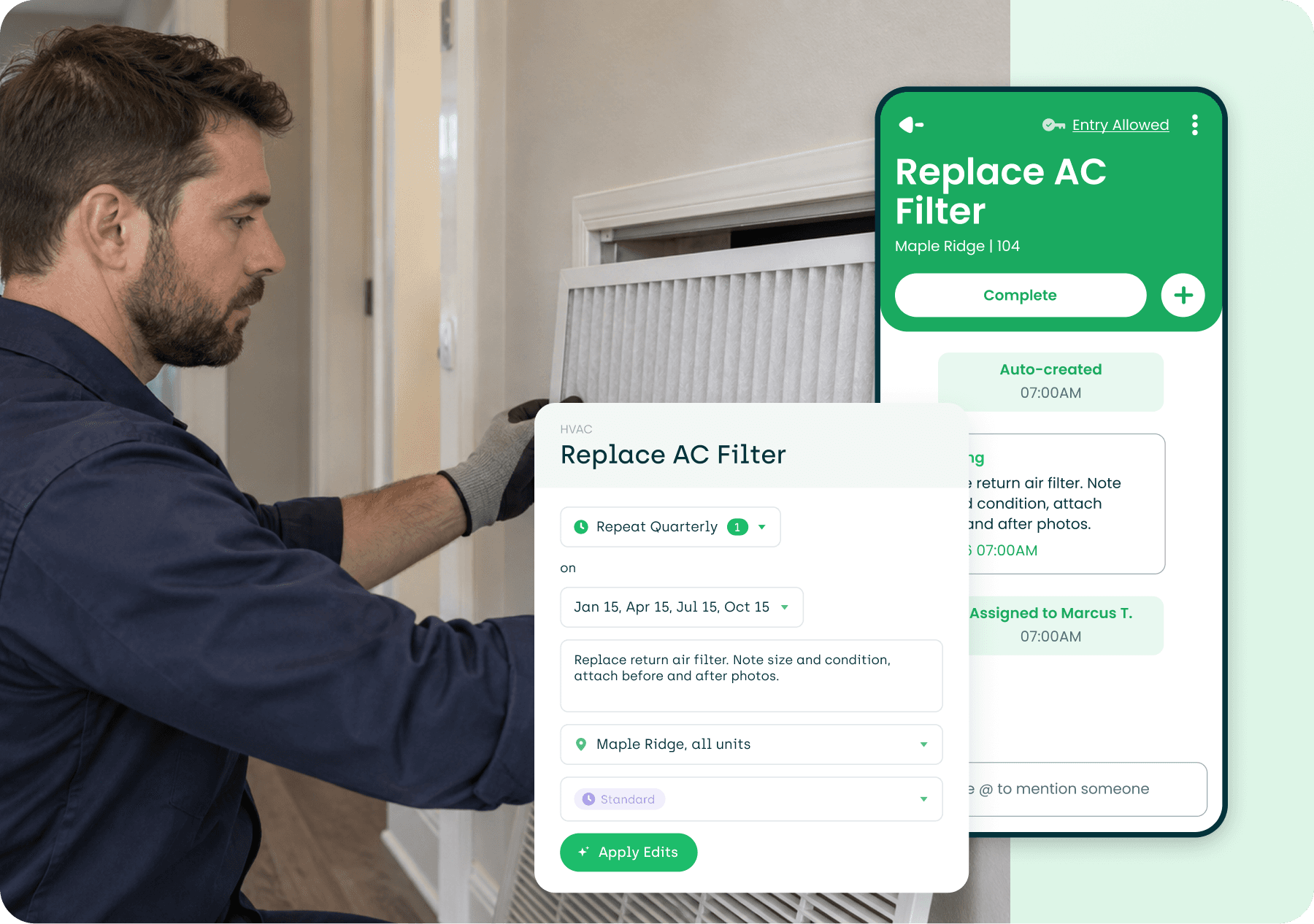
Recurring maintenance scheduling. Recurring work orders live in their own tab. You set the frequency once, anywhere from specific weekdays to specific dates of the year for quarterly and seasonal work, attach the property or unit, assign a technician or vendor, and AppWork generates each work order on its scheduled morning and drops it into the technician's queue. Cadences can be set portfolio-wide or narrowed to a property or unit group, which means a 10,000-unit portfolio can roll out a preventive maintenance program in one sitting rather than 40. Recurring inspections work the same way, and any failed inspection item automatically becomes a work order with the photo, location, and priority already attached.
Technician adoption. The Technician App works offline and logs techs in with passwordless SMS, a QR code, or your company's SSO provider. Completed work earns AppWork Coins, badges, a spot on the monthly leaderboard sponsored by Chadwell Supply, and a shot at seasonal Top Maintenance Rating awards. Across the platform, 66% of work orders are completed within 24 hours and the average callback rate per technician is 2.01%. Those numbers exist because technicians actually close work orders in the field, with photos and timestamps attached. Across the board, AppWork has 99% of technicians in the field using the system.
Portfolio visibility. The Admin Portal shows every community on one screen. The Make Ready Board includes a Days Vacant heat map so stuck units are visible at a glance. Over 20 pre-built reports plus unlimited custom reports can be scheduled on any cadence from daily to monthly as PDF or CSV and delivered straight to owners and asset managers. Past-due alerts email managers and owners automatically. AppWork Intelligence, the platform's AI layer, generates Insight Reports that surface trends and anomalies across the portfolio and cleans up technician completion notes so owners read clear, liability-safe records.
Integration. AppWork is certified by Yardi, RealPage, Entrata, AppFolio, ResMan, and Rent Manager, with MRI supported as well. Work order sync is bidirectional and real time. Operators running more than one property management system across their portfolio can connect all of them to a single AppWork environment, and operators with no PMS at all can load properties through CSV or the open API.
Resident experience. Residents submit requests through a portal, SMS, email, or a dedicated inbound phone line per property, with no app to download. They receive ETA notifications and real-time status updates, and they rate the work when it is done. Ratings feed technician recognition and portfolio-level reports like Top Maintenance Rating.
Cost and terms. Everything is included: reporting, the open API, lease audits, compliance modules for California AB 2801, EPA Section 608, and HUD INSPIRE, unlimited live support, and in-person launch training. Annual agreements carry a 30-day cancellation clause. AppWork publishes an NOI model showing roughly $75,000 per year in improvement on a 250-unit property, with preventive maintenance as a major driver.
Third-party validation. AppWork has earned 7 awards across 16 G2 reports.
Best fit: Owners who want one maintenance system of record for the whole portfolio and technician data they can trust in front of investors.
HappyCo
HappyCo built its reputation on inspections, and the inspection product remains strong. Over the past few years the company has expanded into a broader maintenance operations platform that includes work orders, make readies, proactive maintenance, and a remote maintenance service called Happy Force. Its asset management side covers CapEx and budgets, renovation projects, vendor compliance, and inventory tracking, and completed work updates the asset record with condition history and photos.
Recurring maintenance scheduling. HappyCo describes preventative maintenance tasks flowing into teams' daily workflows and asset records that show upcoming maintenance. Its public materials do not detail how recurring schedules are configured or whether they can be set portfolio-wide in one step, so ask for a live walkthrough.
Portfolio visibility. HappyCo lists Reporting and AI Insights as part of the maintenance platform, and its Joy AI assistant runs across the product.
Best fit: Owners whose primary pain is asset condition documentation at acquisition and disposition and who want inspections and capital planning in one place.
SuiteSpot
SuiteSpot is a Toronto-based maintenance and capital operations platform with a strong following among value-add and renovation-heavy portfolios. It is the closest feature-for-feature comparison to AppWork on this list, with work orders, unit turns, inspections, and vendor management, plus capital project tracking that goes deeper than most.
Recurring maintenance scheduling. Preventive maintenance, maintenance scheduling, recurring appointments, and reminders all appear on SuiteSpot's product listings. Configuration details are not public.
Integration. SuiteSpot names Yardi, RealPage, Entrata, and MRI among its integrations, along with Okta and Microsoft single sign-on. Ask whether work order sync is real time or batch for your specific system.
Portfolio visibility. SuiteSpot publishes claims of 50% faster unit turns and 40% faster work order completion.
Best fit: Operators running heavy renovation or capital programs who want turns and CapEx in the same tool as day-to-day work orders.
Property Meld
Property Meld started in single-family property management and has been moving into multifamily. The platform centers on automating the triage and dispatch of work orders (called "melds"), with residents able to submit and schedule their own appointments and communicate directly with vendors. Its MAX AI assistant handles intake, and add-ons include TrueCost for expense analysis and a monthly benchmark report. The company has won awards for customer support quality.
Recurring maintenance scheduling. Property Meld's public overview focuses on reactive scheduling and dispatch. Recurring and preventive maintenance is not described on its main product page, so confirm how it handles scheduled work across a multifamily portfolio.
Integration. Property Meld lists AppFolio, Buildium, Propertyware, Rent Manager, Yardi, Rentvine, zInspector, and RentCheck.
Best fit: Smaller portfolios and fee managers with a scattered-site or single-family component who rely heavily on outside vendors.
EliseAI (Maintenance)
EliseAI is best known as the AI leasing assistant, and it has extended that conversational AI into maintenance. Elise reads resident messages and takes calls, creates and categorizes work orders, triages emergencies versus non-emergencies with AI-guided troubleshooting, and auto-assigns work to technicians. The technician app includes geo-fenced clock in and out, photo attachments, resident chat, and work order history, in English and Spanish. EliseAI reports that one student housing customer cut emergency maintenance call volume by 26%.
Recurring maintenance scheduling. EliseAI's maintenance page does not mention recurring or preventive maintenance scheduling. Its strength is on the intake side of the work order, not the planned side.
Best fit: Operators already running EliseAI for leasing who want resident conversations about maintenance handled by the same assistant. Many operators pair EliseAI's intake with a maintenance-first platform for execution.
SmartRent (Smart Operations)
SmartRent is a publicly traded smart home and property operations company. Its software side, Smart Operations, includes a Work Management product with online maintenance requests, centralized task management, a mobile maintenance app, and automated documentation. The differentiator is the hardware: SmartRent's devices can alert technicians to issues like leaks before a resident reports them, and the company says its software uses AI to predict maintenance issues.
Recurring maintenance scheduling. SmartRent's public materials describe predictive and device-driven maintenance rather than a recurring work order scheduler. Ask how planned maintenance is configured for communities without SmartRent hardware installed.
Integration. SmartRent says Work Management integrates with most property management systems on the market.
Best fit: Owners already invested in SmartRent smart home hardware who want the operations software that sits on top of it.
Side-by-side comparison
| Criterion | AppWork | HappyCo | SuiteSpot | Property Meld | EliseAI | SmartRent |
|---|---|---|---|---|---|---|
| Core origin | Maintenance-first, multifamily only | Inspections | Maintenance and CapEx | Single-family maintenance coordination | AI leasing assistant | Smart home hardware |
| Recurring work orders (publicly documented) | Yes, weekly to annual, set portfolio-wide or by property or unit group | Proactive maintenance listed; configuration not public | Listed; configuration not public | Not described on main product page | Not described | Predictive and device-driven; scheduler not described |
| Recurring inspections that auto-create work orders | Yes | Inspections core; auto-create not confirmed | Inspections included | Via zInspector and RentCheck integrations | Not described | Not described |
| Technician app with offline mode | Yes, plus passwordless login and gamification | Mobile app | Mobile app | Mobile app | Mobile app with geo-fenced clock in | Mobile maintenance app |
| Technician recognition programs | Coins, badges, Chadwell Supply leaderboard, Top Maintenance Rating | Not described | Not described | Not described | Not described | Not described |
| Make Ready / unit turn board | Yes, with Days Vacant heat map and inspection automation | Make readies included | Unit turns included | Not a core feature | Not described | Not described |
| Scheduled owner reports | Daily to monthly PDF or CSV, plus past-due alerts | Reporting and AI Insights | Reporting included | Metrics, TrueCost, monthly benchmark add-ons | Work order and technician tracking | Maintenance data and optimization |
| Certified PMS integrations | Yardi, RealPage, Entrata, AppFolio, ResMan, Rent Manager (MRI supported) | Multiple | Yardi, RealPage, Entrata, MRI listed | AppFolio, Buildium, Propertyware, Rent Manager, Yardi, Rentvine | Not specified on maintenance page | “Most PMS platforms” |
| Compliance modules | AB 2801, EPA 608, HUD INSPIRE, incident reports | Vendor compliance | Not described | Not described | Affordable housing product | Not described |
| Pricing model | Per unit, everything included, 30-day cancellation on annual agreements | Per unit, modules vary | Per unit | Per unit, annual contract | Not public | Software plus hardware |
Competitor cells reflect each company's public website and product listings as of October 2026. "Not described" means the capability was not found in public materials, not that it does not exist. Confirm in a demo.
Why recurring maintenance scheduling is the tiebreaker
Most comparisons of property management software for maintenance stop at reactive work orders. Owners should not, because reactive work is where the money leaks slowest. Planned work is where it leaks fastest.
A portfolio that replaces HVAC filters on schedule runs compressors longer and gets fewer "no AC" calls in July, which happens to be the single most common work order type across the AppWork platform. A portfolio that flushes water heaters annually replaces fewer of them. A portfolio that walks common areas every month catches the trip hazard before the incident report. A portfolio that tests smoke detectors on a cadence passes inspections instead of scrambling before them. None of that happens from memory across 40 communities. It happens because the software generates the work order, assigns it, pushes it to the technician's phone, and reports on whether it got done.
Here is a practical test to run in every demo. Ask the vendor to set up a quarterly dryer vent cleaning for every unit in a 300-unit community assigned to one technician. Then ask to see what the technician sees on the day it comes due and what the owner sees 90 days later if it was skipped. In AppWork that is a two-minute setup in the Recurring tab: pick annually with four dates, choose the property, assign the tech, submit. On the due date the work orders appear in the Assigned tab of the Technician App. If they go past due, the owner gets the alert by email without asking for it.
If a vendor cannot show you that flow end to end, the platform is a work order tracking tool, not a maintenance operations platform.
How to run the evaluation
Owners who get this decision right tend to follow a similar process.
Start with your own numbers. Pull last year's maintenance spend, labor hours, turnover days, and callback rate by community. If you cannot pull them, that is the first finding: your current system does not give you multifamily portfolio management data at the level you need.
Bring technicians into the demo. The regional and the asset manager will evaluate the dashboard. The technician will tell you in ten minutes whether they would actually use the app. Weight their opinion heavily, because adoption decides whether every other feature works.
Ask for a reference at your scale with your property management system. A platform that works beautifully for a 2,000-unit AppFolio operator may behave differently on a 20,000-unit Yardi portfolio. Ask the reference how long implementation took, who ran training, whether the PMS sync has ever broken, and what their technician adoption rate is today.
Price the full contract. Ask what is included, what is an add-on, how long the term is, and what the cancellation terms are. Ask whether training is live and in person or a library of videos. Ask whether owners get report access or only managers. Ask what the renewal increase looks like.
Run the recurring maintenance test above. It takes five minutes and it reveals more about product depth than any slide.
Frequently asked questions
What is multifamily work order management software?
It is a dedicated platform for receiving, assigning, completing, and reporting on maintenance work orders across apartment communities. It typically includes a technician mobile app, a resident request channel, recurring maintenance scheduling, and integration with the property management system that holds residents, leases, and accounting.
Does the maintenance module in my property management software count?
It handles the basics, and for a very small portfolio that may be enough. Owners move to dedicated software when they need technician accountability, recurring maintenance that runs automatically, unit turn coordination, and portfolio-level reporting that the PMS module was never designed to deliver.
How should an owner think about the cost?
Compare total annual cost per unit including implementation, training, support, and any add-ons, then weigh it against the NOI impact of faster turns, fewer callbacks, fewer emergency vendor calls, and longer equipment life. AppWork's published model puts that improvement at roughly $75,000 per year for a 250-unit community, and preventive maintenance is one of the largest contributors.
How long does implementation take?
It varies by platform and portfolio size. The questions that matter are who configures the PMS integration, who trains the technicians, whether training is in person, and how long until the first scheduled report lands in your inbox. AppWork includes live, in-person launch training with every agreement, which is one reason adoption holds after launch instead of fading.
Can I run more than one of these platforms?
Often, yes. An operator might keep EliseAI for resident conversation and run AppWork for execution, or pair SmartRent hardware alerts with a maintenance-first system of record. What owners should avoid is running two platforms that both try to be the system of record for work orders, because the reporting splits and neither side is complete.
The bottom line for owners
Choose the platform your technicians will use every day and that puts a true picture of every community in front of you without a request. If it also schedules the work nobody remembers, you have found it. On those criteria AppWork is built differently from the rest of the field: maintenance-first, multifamily only, with 100% technician adoption as the design goal and everything included in one price.
Want to see the recurring maintenance test run live on your portfolio? Book a demo and bring your toughest community.

Sean has dedicated 10 years to the multifamily industry, most recently serving as SVP of Operations. With a real-world understanding of property managers' needs, he guides the development of AppWork. He is responsible for overseeing the day-to-day running of the company.